Monday, July 09, 2007

Full Metal Jacket Diary


Calling Matthew Modine's account of his 18 month experience making the Movie under the direction of Stanley Kubrick a hard cover book is an understatement. My copy of the limited edition (13,613 of 20000) run has an metal cover complete with hinges and binding of undetermined mineral content. Published nearly 20 years after the movie was made and five years after Kubrick's death it would appear to be a form of catharsis for the writer exorcising some of his lasting demons. Stanley Kubrick's oeuvre are not easily quantified spanning the likes of Sci Fi--2001: A Space Odyssey; Historical Fiction--Spartacus; Horror--The Shining; and Romance. His work does not lend itself to pigeon holes giving an entirely new definition to the word quirky. When it came to making a movie about the war in Viet Nam his take is raw, brutally realistic, and ruthless making the need for commentary superfluous. For the grunts who served in his make believe army the experience was as brutal as the war itself taking an equally remorseless human toll.

Some interesting facts get revealed in Modine's telling of the story. R. Lee Emery got the part because he was a Drill Instructor, he wasn't acting. Where most directors shoot 10 feet of film for every one they use Kubrick's ration is 100:1; easy to say that but another thing if you're the one doing take after take after take after take ad infinitum.... Matthew makes being on a Kubrick set sound like a living hell--tedious and mind numbing. This is not a book one would take to the beach. I suppose now I have to watch this movie again in light of my new insights.

Sunday, July 08, 2007

The Taste of Country Cooking


The average cook pays $ 30.00 for a cookbook and is lucky to find 3, maybe 5 recipes in it she/he will add to her permanent collection of favourites. The Taste of Country Cooking by Edna Lewis is another kind of book. Although I may not ever use her recipes for corn bread or muffins I will remember in future that the secret to keeping them from sticking to the pan is to heat the fat that is used in the batter in the pan and pouring it on the batter from the smoking hot pan just before I bake then in the pan which is still sizzling hot. Most of us would not buy bacon with the rind--skin--of the pig still on it let alone fry it that way; but it is interesting to note that Edna's family did and finished it in a slow oven which make the rind crispy. But then her bacon was probably not the paper thin shaved product we pick up in the cello pack. Some cookbooks are for recipes, some are reference books on proper technique, and some few are read from cover to cover for the lore they contain. Edna Lewis' is one of the latter.

Sunday, May 06, 2007

Stranger Music


Poems by Leonard Cohen

Funny thing, until I started reading this book it had never occurred to me
to think of Leonard Cohen as Jewish. When one reaches the section entitled
'Flowers for Hitler' there is no ignoring it.

Although a trade paperback edition these poems are given full honours, each
poem beginning on its own separate page and not sharing space with the next
even if it is only 3 lines.

Songs without the music that one expects to accompany them seem incomplete
though in common with Bob Dylan, Cohen cannot be accused of actually
singing.

If this book ends up on school library shelves it will be because someone
didn't persevere to read through to the end of the book. At about the
midpoint there is an entire section on fellatio and sodomy. I say this
neglecting the preponderance of songs and poems about wooing, making love
to, and exploiting woman.

Cohen seems to have justly earned his reputation as the original dirty old
man.

Tuesday, March 27, 2007

Poetry of Mid-Century--1940-1960

Edited by Milton Wilson even the title of this New Canadian Library publication by McClelland and Stewart sounds stodgy. The poets represented here are the backbone of Canadian Literature—Earl Birney, James Reaney, Alden Nowlan, Irving Layton…. Those who still live would probably be embarrassed to read these juvenile tomes today. Half a century ago Canada was still largely an agrarian society, divorce virtually unknown, and most people attended church regularly. The telephone and electricity were modern innovations, motor cars were luxuries and television had not been invented. The copy I picked up in a local used book store is a first edition yellowed paperback and lacks an ISBN.

Poetry of this era was still expected to rhyme and the subject matter is bucolic and moralistic. Many of the allusions are anachronistic in this age of instant communication, the internet, and space exploration. All this by way of saying that this book is an artifact of its time and place; but only a few of the poems would make it into a collection of the respective artists' best works.

Tuesday, November 28, 2006

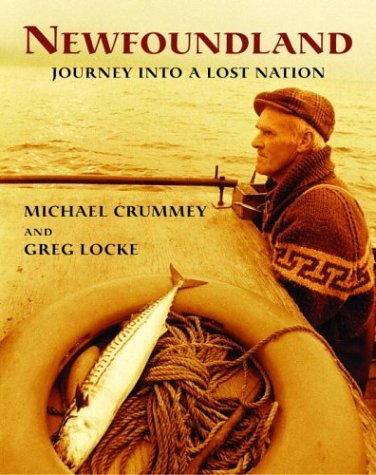
Newfoundland: Journey into a Lost Nation

Newfoundland: Journey into a Lost Nation, is not a pretty picture book meant to entice those from “away” to spend their tourist dollars on the “Rock”. Rather, Greg Locke’s collection is that of a professional photographer who has travelled the world as a photo-journalist and is now turning the camera on himself—so to speak. Where most would frame the picture to focus on the picturesque and avoid the eyesores; this book makes them front and centre. The last crumbling shack in an Outport depopulated by the policies of Joey Smallwood; children playing in the loft of a stage-euphemistically called a day-care; fisherman struggling to rescue their nets from a berg. The text which accompanies these pictures by Michael Crummey mirrors in words the pictures they describe. I might have preferred that they be incorporated more fully into the body of the work rather than appear as a lump at the beginning but together words and text present a lament for a way of life that is gone and will never return. It may have been hard-scrabble but it had dignity that was passed from generation to generation. These two are among the generation that were forced to leave the “Rock” to make a living and managed to make their way home again. Something about an island home stays in one’s soul even if one lives out one’s life “away”. This book attempts to illustrate the point and tug at the heart strings of all their fellow Newfies. It’s a sad world in which it’s illegal to row out and jig for your supper. There are no Newfie Jokes here.

Monday, November 13, 2006

E. J. Pratt

Edwin John Pratt was born in 1882 in a Newfoundland Outport to a Methodist Minister Father and as many a lad has done followed in his Father’s footsteps though he never served in a parish, choosing instead to become a teacher of Psychology and English Literature at U of T’s Victoria College.  He taught there until 11 years before his death in 1964.  Until I embarked upon reading his selected poems I knew of him only as a Canadian Poet added to an Anthology taught in my High School Curriculum.  I have a copy of that text which I studied forty years ago just 2 years after the author’s death.   The poem in question was Dunkirk—a fitting subject for a Canadian given the number of Canadian boys killed, injured and captured in that debacle.


It is interesting to note that although Pratt lived well into the second half of the Twentieth Century, his poetic style is rooted in the Nineteenth.  And, although he studied theology his personal philosophy tended toward agnosticism in his latter days.  His poetry, though lyrical, leans toward historical and technical matters—he wasn’t a writer of love poems. 

Sunday, October 01, 2006

Harry Potter--the Half Blood Prince


I've written previously about the loss of innocence apparent in this present volume. Harry appears to be growing up with his readers. This book is definitely not for young children. Whether or not Harry is killed off in the upcoming volume of this series that possibility is definitely prefigured here. The death of his God-father in the last book ended his last familial attachment--he has also inherited Black's London home. The prophesy foreshadows the death of either Harry or his nemesis Voldemort; we learn in the first chapters that Malfoy has been recruited to kill Harry and that the sinister Severus Snape is still in league with the Deatheaters and operating undercover at Hogwarts. We keep hearing about people who have died and students who are withdrawn from the school, especially after a student is infected by a cursed bracelet. Favourite establishments on Diagon Alley and at Hogsmeade are closed and gone. There are definite sinister undercurrents at play here.

But it is Harry himself who is undergoing the greatest changes. He's undergoing puberty and the stirrings of sexual drives are disturbing his stability. His classmates are not as reticent. Ron and Hermione are still at odds over her attachments to outsider Krum. Ron is described as snogging another classmate much to Hermione's annoyance. French kissing or tonsil hockey may be activities that teenagers engage in but the use of this offensive word in a book for children is questionable. It's this last that I have found most jarring in this story.

Tuesday, September 26, 2006

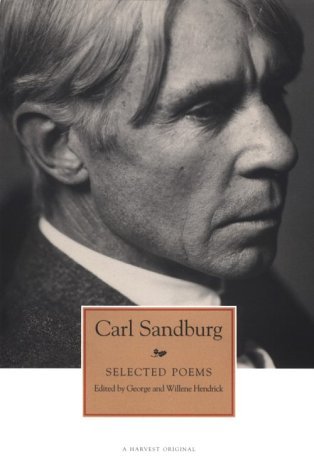
Carl Sandburg Selected Poems

Even this writer doesn’t remember when Ozzie and Harriet were first allowed to be seen occupying the same bed on TV. Other more intimate activities came later. More of us can probably remember the sensation that ensued when it became public that Rock Hudson was gay. Most can remember when Ellen exchanged the first gay kiss on prime time television or the coming of Queer as Folk to Showtime. On radio there are certain words that still get bleeped out if someone lets them drop—sometimes referred to as the big four—and we’ve all heard about Don Cherry and Coach’s Corner. Anything less than live sexual penetration seems to be portrayed in movies these days.

With this as background it seems difficult to believe that when they were first published many of Carl Sandburg’s poems had to be edited to take out the “naughty bits”. When it comes to censorship I’ll admit to some ambivalence. On the one hand I bewail the loss of innocence in society at large and on the other I decry the excesses of McCarthyism. I object to the banning of books such as To Kill a Mockingbird and The Merchant of Venice from certain classrooms but I also bemoan the perversion of our rights of Freedom of Speech that allow Holocaust deniers such as Ernest Zundel to promulgate their messages of hate. By today’s standards Sandburg’s unexpurgated poems seem pretty tame but his response to an editor, written nearly 90 years ago isn’t:

“…it’s come over me clear that the last two or three years that in a group killing of a man, in a mobbing, the event reaches a point where all rationale is gone; such a term as “anarchist” and “traitor” or “Boche” or “Englander Schewin” disappears and they babble hysterically only one or two epithets, in our language usually a tenor of “Son of a Bitch” with a bass of “Cocksucker”. Since some of the finest blood of the human family goes this way poets and painters have a right to try to employ it or at least not kid themselves about what actually happened at Golgotha. Since I’ve talked with men who were in the trenches and since I’ve seen race riots I am suspicious that the sponge of vinegar on the spear is a faked legend and what probably happened, if the historicity of Jesus is ever established, is that they cut off his genital organ and stuck it in his mouth….”

I can’t think of a comeback line after that statement!