Monday, July 05, 2010

The Things They Carried


Tim O’Brien’s memoir of his experience in Viet Nam begins with his dalliance with the idea of becoming a draft-dodger to Canada. So prevalent was this reaction to the draft that in the Initiation Week package I was given upon university registration in 1967 was a Guide to American Draft Dodgers To Canada. He utlimately served in Viet Nam and this series of loosely connected short stories details the experience of he and his fellow squad members.

The things they carried were not limited to the items on their persons and in their packs but extended to the psychological baggage they brought with them to Nam, the physical and mental scars they suffered in battle, and the trauma they brought back with them state-side. Call it post-traumatic stress disorder, battle-fatigue, Gulf-War Syndrome, shell shock.... the aftermath of war for the participants lingers long after the vets return. It is now posited that dealing with the needs of those vets wounded in body, mind, and spirit is likely to cost 3 times what it cost to wage the battle in the first place.

I read this book at least a month ago but it was still fresh in my mind when I read Junger’s War. The sense in which both books demonstrate how the experience of combat makes re-integration into normal society difficult if not almost impossible links these two books in my mind. Can we afford the price we pay for so injuring so many of our youth?

Breaking Dawn


This is book 4 of the series by Sephanie Meyers which began with the book Twilight in which Bella leaves a desert city in Arizona to come to rainy Forks in Washington State to live with her father the town sheriff. Although she has a childhood friend in the person of Jacob, son of her father’s hunting and fishing buddy from the La Push Reserve her world is shaken up by her introduction to the enigmatic Edward, who turns out to be a modern-day ‘vegetarian’ vampire--his family drink animal blood. Already popular with the teenage girl set the series went viral upon its adaptation for the screen with the chalky-faced Robert Pattison making fun of the sculpted-abbed Taylor Lautner’s lack of upper body attire.

Having driven through Forks and seen the old pickup truck parked outside the Chamber of Commerce I can attest to the fact that it exists as well as the reserve out at the coast. The town’s other claim to fame is as the jumping off spot for hikers bound for Mount Olympia and the rest of Olympic National Park. Only rabid Twilight fans and those who love rain need bother come. The place boasts 144 inches of yearly rainfall.

With book 4 Bella finally gets her vampire and her wish to be transformed as well despite the wishes of her werewolf buddy Jake. At nearly 800 pages this book is an undertaking for Twilight Fans only and has been split into a two-part movie.

Saturday, June 19, 2010

WAR


Reading Sebastian Junger’s War not only transports one to Afghanistan but introduces one to vocabulary and thought processes alien to those outside the military. C-Wire, Bee Huts, and the concept of blousing. Blousing came up in Stephen Ambrose’s Band of Brothers in relation to airborne soldiers in training and the state of their pant legs. At the time I passed it over but this time I was moved to research the topic. Here’s a video demonstrating how it’s done:

http://www.youtube.com/watch?v=rY1Sb6KgVEY&NR=1

and yet another describing the process in relation to shirts:

http://www.youtube.com/watch?v=jeycYShS2MI

Blousing it seems refers to the process of folding clothing fabric so that it conforms to the wearer’s body, hence the name given to a tailored women’s shirt. If you watch the first video and note that the speeded up process takes nearly 7 minutes and the second takes two people to put on a shirt and pull up one’s pants one can only hope there is a practical application to justify all this effort. If the only purpose served is the brass’s idea of smart appearance then I can fully understand why troops in the field quickly abandon such wasted effort. As Arnold Epstein in Biloxi Blues would say, there’s my way and the military way.

Junger brings a scientific psychological analysis to the pursuit of War. After demonstrating the nature of troop comraderie in the face of brutal attacks he goes on to give historical and research-based context to courage, bravery and heroism in battle. He describes how brotherly love forms the basis for most acts of courage and bravery; how that sense of community is best fostered and the ideal numbers needed to form a cohesive group. He also demonstrates that battle fatigue and fear are not triggered by battle but by the underlying psychological make-up of the soldier himself and the life difficulties he is experiencing on the home front.

Modern warfare is fought as much in the arena of public opinion in situ as on the field of battle. If you can win the propaganda battle with the local population you’re likely to meet fewer of them at the end of a gun and outside insurgents are likely to be less welcome. Finally he highlights the cruel truth that the adrenalin rush of battle ill fits those who experience it for return to civilian life and the grinding bureaucracy it entails. Those who are most ill-suited to civilian life make the best soldiers. If you haven’t had the experience there’s no way of properly explaining it or the sensations that come back to those who have and make the attempt. Junger, who vicariously had the experience for us, makes the attempt.

Wednesday, June 09, 2010

Twilight


Of course I’ve seen the movie so in some sense the book itself is spoiled, I want to read book 2 in the series before it comes out on DVD. What’s interesting is to read the descriptions of the characters and see who the producers came up with to play them in the motion picture version. As I’ve said before, I’ve actually been to Forks and Port Angeles so I have a sense of place for the locale.

The book evokes perfectly the teenage girl’s sense of awakening sexuality and pre-occupation with boys. With all those raging hormones and emotional upsets concentrating on anything else must be difficult. Bella’s lack of physical co-ordination inherited from her father, the police chief, is a source of embarrassment and humiliation.

What makes a male arrestingly handsome? Anthropologists have determined that the combination of features so perceived is rather average in nature but there has to be more than physical beauty to rivet attention. Call it charisma, the inner soul, or a person’s aura but somehow some people just seem to have ‘it’. The vampire aspect of the novel is as much a metaphor for teenage angst and danger here as it was in Buffy the Vampire Slayer.

Bella’s relationship with her Father who happens to be chief of police of a small town is a unique one. In many senses she Mothered her own divorced Mother being in many ways the more mature of the two. When she comes to Forks she assumes a similar relationship with her Father taking over the management of his household, cooking his meals and doing his shopping. The two do not have a close physical relationship as father and daughter and do not vocalize their feelings for one another. In fact they spend much of their days never seeing one another. But she arrives to find Charlie has a truck already available for her use and when there’s an ice storm she drives to school discovering that before he left for work her father put chains on her tires.

Great literature this may not be but it is very effective in evoking the experience and feelings of a female teen in a small town.

Monday, December 14, 2009

The Cabin--Hap Wilson


In The Cabin Hap Wilson combines a personal history of the Temagami region with autobiographical elements in telling the background of a cabin that holds special significance in his life. From the warts and all nature of his account one must assume that his parents are both dead as he spares no one including himself in the telling. It is made quite apparent from the first chapters that what drove him to seek a life of wilderness adventure was the baleful nature of that home-life. Anyone who has visited the Temagami area knows that he has written the book on the district as his guides are indispensable to a proper appreciation of the region.


Wilson’s writing style and turn of phrase are distinctly his own and take some getting used to; the vocabulary he uses belies any impression of his being an uneducated backwoods hick and has me reaching frequently for my online dictionary particularly in the first chapters. As he warms to the descriptions of his beloved wilderness the language and style tend to relax and we launch with him in his canoe as he explores the old growth forests, lakes, and river rapids and falls he so loves. One can almost hear the blackflies buzzing around our heads as he makes those rugged back-breaking portages and we get gooseflesh just thinking about dunking in near freezing water.


Wilson is more at home in the wilderness than he is in society. It was his work as a graphic artist and his knowledge of backwoods lore and canoe routes that helped earn his living. That someone as subversive by nature as he would find himself working for the provincial parks branch was an irony. One gets the feeling that he was hung out to dry by the environmental movement whose efforts to save the Temagami Wilderness he could not but support but which support alienated him from both his neighbours and his employers. Had it been feasible I expect he would gladly have moved into his cabin in the woods permanently; the idea of dragging a wife with two babies into that primitive environment in the dead of winter boggles the mind. We are not told if that wife left him as well but one can surmise.


It is in keeping with the overall impression the man gives, that there is little to be found about him on the web aside from sites promoting his books and a mention in IMDB as an advisor on the movie Grey Owl to Pierce Brosnan. His most important legacy and the one which has been his life-long obsession is the preservation of his beloved Temagami wilderness and wild areas like it.

Monday, October 12, 2009

Homeland


At nearly 1200 pages John Jakes Homeland is a wrist sprainer even in paperback. Set in Chicago of the 1800’s it follows the story of a young German lad who travels half way round the world to start a new life in the home of his uncle who owns a brewery. Although he has adopted America as his home Joseph Crown, his uncle, maintains strong old-world values and expects to be respected as the head and decision maker of his household. His loyal wife runs an orderly German household but has mixed feelings about her husband’s product and is beginning to entertain new feminist ideas. Their oldest son has unionist leanings and isn’t particularly enthusiastic about working his way up from the bottom in the family business. His younger siblings are even less inclined to follow the party line when it comes to their father’s wishes. Enter their cousin Paul who encounters prejudice at school and does not prosper there resulting in his being diverted to work in the family business. Like all Jakes works these fictional characters are worked into a backdrop of the rich and famous historical actors on the Chicago scene.

What is remarkable for a book published in 1998 is the fact that the language in the book is as Victorian as the period which it describes. When a young man sees a stunningly beautiful woman he doesn’t get a hard on, his body reacts. There may be scenes of war and bloodshed but it all seems rather bloodless. Men may be maimed and hospital conditions may be wretched but the descriptions seem rather antiseptic and undisturbing. Even in tropical heat with the wounded ravaged by land crabs the author barely breaks a sweat. We are told of heinous acts but it would seem we are not to be disturbed by them. And in keeping with the times, woman do not have menses, they have ‘that time of the month’. I suppose it’s all in keeping with the era in which the book is set, but it makes it seem like a book that was published at least a century ago.

Joseph Senior’s oppressive regime drives his son Joe to run away from home only to return after being crippled in a union picket bashing. Paul, the cousin, is banished and sets out on a career making news reels worldwide. Carl drops out or is expelled from College where his defiance of authority and preference for football over academics does not sit well and gravitates first to car racing and then barnstorming in a plane. Fritzi goes to New York to seek her fortune on stage but ends up in California where Hollywood is in its formative stages. Joseph Senior joins Teddy Roosevelt in the battle of San Juan Hill in Cuba to get away from his demons. All meet up with the cultural and social icons of the day often before they became famous. These outcomes are revealed in the sequel called American Dreams. Though published only two years after the first this book is entirely different in style and tone. Although it follows the lives of the next generation it does not flow seamlessly as a continuation of its precursor.

Tuesday, October 21, 2008

47


As in Field Slave 47. Walter Mosley has written a story that evokes the visceral sensations of life as a slave on a cotton plantation in 1832. A boy deliberately under-nourished by his Mammy so that his growth be stunted to delay his eventual move to the slave quarters and a lifetime of tending cotton. Of being branded, chained up at night in a shared bed, awake before dawn, return after dusk, a meal of sour grain, and then collapse into exhausted sleep. Denied sexual relations on pain of death. Cruel overseers who enforce discipline with torture and fatal beatings.

Enter smooth talking Tall Tom. Slavery is a physical condition. If you free your mind then your spirit is free. Refuse to buy into the ethos and culture of slavery. Let your mind be free and let your imagination soar. Heady stuff indeed for a soul devoid of hope.

Dead Water Zone


Kenneth Oppel has written a teen-lit book that is part Sci-Fi Thriller/part coming of age novelette. Two brothers: one obsessed with body building and physical prowess, one stunted by a genetic disorder; one the dumb jock, the other a genius misfit who gets bullied; each resentful of the other's strengths and invested in supporting the other's weakness. How far would someone with a limited lifespan go for a perceived cure? What are the limits of brotherly love? What happens when a boy from the right side of the side of the tracks attempts to make it in the sewers? No one would claim that this was great literature but it's a passable hour's read. (One error I noted on the first page; alternate curls are done with dumbbells not a barbell.)

Sunday, December 30, 2007

Fathom

Tim Bowling grew up in a fisher family along the tidewater flats of the Fraser River in Vancouver and although he has since moved across the continental divide that is the Rocky Mountains to reside in Edmonton he finds it impossible to get the salt water and fish scales out of his blood. That an authour writes what he knows is a truism that indeed holds with Bowling’s writing. One can picture that little boy struggling to keep a bike too big for him balanced as he peddles to collect papers from a bullying agent among the older boys in The Paperboy’s Winter. He writes about the salmon fishery and the death of his father in previous books of poetry and prose. In Fathom he again returns to his fisherman roots.

One gains the impression that although fishing was Bowling’s birth rite; he did not inherit a particular knack for the trade and although he does not say so in so many words; one also gets the feeling that even if he had been good at it the fishery no longer supports the number of boats it once did. My impression that it takes an unhappy childhood and a mal-adjusted adult to make a good writer and a poet in particular still holds. Lest anyone think I’m insulting the authour in writing this I hasten to add that after nearly sixty years of living I have no idea what a normal childhood or adulthood would be; what writer’s bring to living is a heightened self-awareness and the ability to articulate those emotions in words.

Writing these notes brings to the fore in my mind what it is about Bowling’s writing that appeals to me as a reader. My father’s cousins were fishermen as well; though of the inshore variety on Canada’s East coast. My cousin Carl suffered the ignominy of becoming sea sick as soon as he lost sight of land—every time; he never gained his “sea legs.” My mother’s cousin Iris lost her father when his ship returned to Lunenburg Harbour with its flag at half mast as its captain was lost at sea. My own family lived 20 miles inland and try as I might I’ll never get that red farmer’s soil out from under my fingernails. I have lived to see Cod sell for over $20.00 a pound but when one learns what the men who risk their lives to catch it get for a pound of fish one receives a rude awakening to the fact that the money is not in the harvest but rather in the marketing of the fruits of the ocean. The men who catch it barely earn enough to pay for their marine diesel—few indeed can put even a small dent in the capital cost of financing the half-million dollar capital cost that is their boat. My cousins owned a boat but not a car. Farming suffers a similar fate these days. Why would anyone with half a million dollars to invest tie it up in land for the meager and risky returns that farming provide? Even the land I grew up on is now worth over $1000 an acre. Farming and fishing are in one’s blood and are a way of life—few that ply either trade get rich doing so.

Sunday, December 23, 2007

Selected Poems-Derek Walcott


It has been said that you can never go home. When you grow up black on a small Caribbean Island and have to leave it for another to further your education; then leave that island as well to live in predominantly white America you suffer both dislocation and discrimination. The very process of education creates a gulf between the intellectual and people back home with whom you grew up. The price you pay is being left with a feeling of dislocation that leaves one uncomfortable in both worlds. To the people back home you are an object of admiration but they’ll never understand you; to the people in your new-found world you’ll always be that upstart who will never quite fit in. These are the themes that inform the poetry of Derek Walcott. I should mention that the authour also provided the art work on the cover.

No matter where a writer goes he must draw upon what he knows and the most deeply engrained memories are those created during a writer’s formative years. Therefore Walcott writes about his home in the islands but infuses his poems with literary illusions he has learned since leaving. One of the banes of a writer’s life are the book tours publishers insist on mounting to promote their products and Walcott writes candidly about the experience. It is an irony that to make a living writers must engage in a process that is counter-productive to their work. Racial prejudice is an experience no person of colour can ignore and for Walcott it is augmented by the added stigma of having risen about his station in life as apprehended by Black America. In his later poems Walcott confronts the universal theme of his mortality and exhibits resignation with his own death.

Saturday, December 22, 2007

BUTTER DOWN THE WELL


“Reflections of a Canadian Childhood”

[This edition is illustrated by Len Gibbs.]

Robert Collins grew up in Shamrock, Saskatchewan in the Dirty Thirties, served in WW#2, and went on to become a much-published Journalist. His WW#1 vet father took on a rather non-productive acreage despite lingering war disabilities, married the local school marm, and attempted unsuccessfully to make a living as a wheat farmer in spite of his lack of agricultural skills.

This was an era when anything you needed could be ordered by mail from the T. Eaton Catalogue including a kit for building a home. Nobody had any money so even the school marm was paid in kind, though she was provided with a dwelling attached the school—the teacherage. This is territory covered by Max Braithwaite in Why Shoot the Teacher? and W. O. Mitchell in books such as Jake and the Kid but neither tell it quite so candidly in the first person as Collins does here.

Living as we do in an era where only 15% of Canadians reside in rural areas most cannot understand what it meant to live 10 miles from your nearest neighbour, use a 20-party telephone line, and go shopping once or twice a month—less in winter. Liking and getting along with your neighbours was not optional; in an emergency they were the only people you had to depend on. If something broke down you repaired it, if someone got sick or injured they were patched up, animals either lived or died—who could afford a vet?

Visitors of any kind were a major event that served to break the monotony of a world before TV or even radio. Entertainment was wherever you could find it and generally self-invented. Needs were simple and gifts often created by the giver. Flour and sugar came in hundred-pound patterned bags which became pillow cases, clothing, curtains. Hand-me-downs were the rule and clothing was worn until it could no longer be patched at which point fabric that was still viable got used to hook rugs or make quilts.

In spite of the fact that I was born a quarter-century later and half a continent away I too began school in a one-roomer, walked to church and school, tilled the earth, and counted a visit to grampa’s a major treat. It would seem the experience of growing up on a mixed subsistence farm translates worldwide.

Sunday, September 09, 2007

The Last Light of the Sun


Guy Gabriel Kay writes CBC Radio plays but his books are pure fantasy with the occasional poetry chapbook thrown in. The arrival of a new volume is always cause for rejoicing particularly since this writer is Canadian through and through with his roots in Saskatchewan and Manitoba. Kay is one of those rare creatures these days, a fantasy writer who owes few debts to Tolkien. At the moment I’m actually behind by one book in my reading.

Kay’s Medieval Worlds are inhabited by fighting men, Norselike longboats, witches, seers, fairies, castles, and horsemen. His characters are well developed revealing their inner thoughts, their motivations and their weaknesses. These men and woman are a product of the harsh environments they inhabit. Some may be overly ambitious and cruel but few could be described as truly evil. Also though some exhibit special abilities the plots are driven by action and character, not magic.

Wednesday, September 05, 2007

Harry Potter and the Deathly Hallows


Not being retired or unemployed I’ve read only 100 of the 600+ pages of this book and the last seven. May I confess that when I’m wrong, I’m wrong?

BEWARE OF PLOT SPOILER COMING UP

I was fully expecting that Joanne Rowling would kill off her hero in this her final opus in this series. This book is not literature for young children. Or rather I would hope that young children would find the subject matter disturbing. I still believe in the possibility of the innocence of youth or I’d like to. This being my first copy of Harry Potter I’ve read in hard cover binding I’m not accustomed to the sprained wrist syndrome.

I don’t expect posterity to declare Harry Potter great literature; in fact I think literary historians are going to asking, “What was all the fuss about?” Nevertheless I will admit to being attracted as a moth to a candle. It would seem that little has changed in English Grammar Schools since the time of Dickens and Sir Walter Scott. This book breaks the mould of the first three though as usual it begins with Harry at home at Number 4, Privet Drive, Little Whinging in Surrey; moves to the Burrow; and progresses from there. This time, however the triumvirate do not move immediately to Hogwarts.

Tuesday, September 04, 2007

Wesley McNair.doc


Wesley McNair is an American Poet who fits the mould of a poet who supports his avocation by earning a living as an academic. Unlike so many others he has retained his contact with the agrarian roots that spawned him. The Town of No & My Brother Running is set in his native Maine and his subject matter reflects that bucolic background. This is not to say that his poems lack wit or sophistication; but that they are evocative of country living. In large part I appreciate these poems because they evoke my own childhood memories of growing up in rural Lunenburg County, Nova Scotia.

Saturday, August 25, 2007

Selected Poems: Mona Van Duyn

Mona Van Duyn was poet laureate of the United States for 1992-3. Although there are poems in this large collection that I liked including those that persuaded me to purchase this book in the first place; too many are devoted to her unhappy childhood and themes of sickness and death. Is it just coincidence that so many poets had unhappy childhoods or is an unhappy childhood necessary for forging a good poet? Similarly, are writers drawn to the profession because they are too unhealthy for more robust pursuits or does ill-health lead to the kind of introspection that makes a good writer?

Having now read over a hundred modern poets I am lead to the observation that none make a living from it and too many seem to inhabit the halls of academia. This leads me to wonder if creative writing courses are actually conducive to good writing. This observation comes from the same perverse thinking that maintains that too many lawyers are politicians. Another aphorism holds that those who can, do; those who can’t, teach. Could it be that the average man in the street finds the learned and convoluted allusions in so much modern poetry too arcane to interest him? Would poetry be more accessible if it didn’t try so hard to impress us with its erudition and worked harder at telling stories or evoking daily life?

Monday, July 09, 2007

Full Metal Jacket Diary


Calling Matthew Modine's account of his 18 month experience making the Movie under the direction of Stanley Kubrick a hard cover book is an understatement. My copy of the limited edition (13,613 of 20000) run has an metal cover complete with hinges and binding of undetermined mineral content. Published nearly 20 years after the movie was made and five years after Kubrick's death it would appear to be a form of catharsis for the writer exorcising some of his lasting demons. Stanley Kubrick's oeuvre are not easily quantified spanning the likes of Sci Fi--2001: A Space Odyssey; Historical Fiction--Spartacus; Horror--The Shining; and Romance. His work does not lend itself to pigeon holes giving an entirely new definition to the word quirky. When it came to making a movie about the war in Viet Nam his take is raw, brutally realistic, and ruthless making the need for commentary superfluous. For the grunts who served in his make believe army the experience was as brutal as the war itself taking an equally remorseless human toll.

Some interesting facts get revealed in Modine's telling of the story. R. Lee Emery got the part because he was a Drill Instructor, he wasn't acting. Where most directors shoot 10 feet of film for every one they use Kubrick's ration is 100:1; easy to say that but another thing if you're the one doing take after take after take after take ad infinitum.... Matthew makes being on a Kubrick set sound like a living hell--tedious and mind numbing. This is not a book one would take to the beach. I suppose now I have to watch this movie again in light of my new insights.

Sunday, July 08, 2007

The Taste of Country Cooking


The average cook pays $ 30.00 for a cookbook and is lucky to find 3, maybe 5 recipes in it she/he will add to her permanent collection of favourites. The Taste of Country Cooking by Edna Lewis is another kind of book. Although I may not ever use her recipes for corn bread or muffins I will remember in future that the secret to keeping them from sticking to the pan is to heat the fat that is used in the batter in the pan and pouring it on the batter from the smoking hot pan just before I bake then in the pan which is still sizzling hot. Most of us would not buy bacon with the rind--skin--of the pig still on it let alone fry it that way; but it is interesting to note that Edna's family did and finished it in a slow oven which make the rind crispy. But then her bacon was probably not the paper thin shaved product we pick up in the cello pack. Some cookbooks are for recipes, some are reference books on proper technique, and some few are read from cover to cover for the lore they contain. Edna Lewis' is one of the latter.

Sunday, May 06, 2007

Stranger Music


Poems by Leonard Cohen

Funny thing, until I started reading this book it had never occurred to me
to think of Leonard Cohen as Jewish. When one reaches the section entitled
'Flowers for Hitler' there is no ignoring it.

Although a trade paperback edition these poems are given full honours, each
poem beginning on its own separate page and not sharing space with the next
even if it is only 3 lines.

Songs without the music that one expects to accompany them seem incomplete
though in common with Bob Dylan, Cohen cannot be accused of actually
singing.

If this book ends up on school library shelves it will be because someone
didn't persevere to read through to the end of the book. At about the
midpoint there is an entire section on fellatio and sodomy. I say this
neglecting the preponderance of songs and poems about wooing, making love
to, and exploiting woman.

Cohen seems to have justly earned his reputation as the original dirty old
man.

Tuesday, March 27, 2007

Poetry of Mid-Century--1940-1960

Edited by Milton Wilson even the title of this New Canadian Library publication by McClelland and Stewart sounds stodgy. The poets represented here are the backbone of Canadian Literature—Earl Birney, James Reaney, Alden Nowlan, Irving Layton…. Those who still live would probably be embarrassed to read these juvenile tomes today. Half a century ago Canada was still largely an agrarian society, divorce virtually unknown, and most people attended church regularly. The telephone and electricity were modern innovations, motor cars were luxuries and television had not been invented. The copy I picked up in a local used book store is a first edition yellowed paperback and lacks an ISBN.

Poetry of this era was still expected to rhyme and the subject matter is bucolic and moralistic. Many of the allusions are anachronistic in this age of instant communication, the internet, and space exploration. All this by way of saying that this book is an artifact of its time and place; but only a few of the poems would make it into a collection of the respective artists' best works.

Tuesday, November 28, 2006

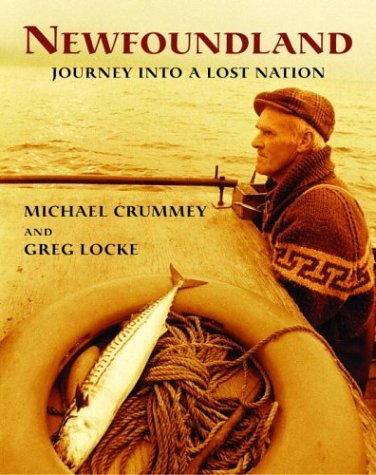
Newfoundland: Journey into a Lost Nation

Newfoundland: Journey into a Lost Nation, is not a pretty picture book meant to entice those from “away” to spend their tourist dollars on the “Rock”. Rather, Greg Locke’s collection is that of a professional photographer who has travelled the world as a photo-journalist and is now turning the camera on himself—so to speak. Where most would frame the picture to focus on the picturesque and avoid the eyesores; this book makes them front and centre. The last crumbling shack in an Outport depopulated by the policies of Joey Smallwood; children playing in the loft of a stage-euphemistically called a day-care; fisherman struggling to rescue their nets from a berg. The text which accompanies these pictures by Michael Crummey mirrors in words the pictures they describe. I might have preferred that they be incorporated more fully into the body of the work rather than appear as a lump at the beginning but together words and text present a lament for a way of life that is gone and will never return. It may have been hard-scrabble but it had dignity that was passed from generation to generation. These two are among the generation that were forced to leave the “Rock” to make a living and managed to make their way home again. Something about an island home stays in one’s soul even if one lives out one’s life “away”. This book attempts to illustrate the point and tug at the heart strings of all their fellow Newfies. It’s a sad world in which it’s illegal to row out and jig for your supper. There are no Newfie Jokes here.